Monday, July 28, 2014

Ethiopia’s emerging art scene pits creativity against profits | Al Jazeera America

Local painters forgo experimentation to cater to growing number of foreign buyers

ADDIS ABABA, Ethiopia — Tesfaye Hiwet started visiting his homeland from the U.S. shortly after the 1991 revolution that brought down Ethiopia’s communist-inspired military dictatorship known as the Derg. One reason was to source art for his Washington-based restaurant and nightclub.
After noticing the lack of galleries in the Ethiopian capital, he moved back to Addis Ababa 12 years ago and opened the Makush Art Gallery and  Restaurant, starting with a handful of artists. Nowadays, every wall in Makush is blanketed with vivid Ethiopian paintings depicting scenes ranging from monks praying in the dawn half-light to bustling markets and images of wide-eyed, elongated women.


Makush owner Tesfaye Hiwet


Makush owner Tesfaye Hiwet relaxing in his office, surrounded by paintings, which make up more than half his business.
James Jeffrey


Addis Ababa has an active art community that can benefit from the lucrative sales at Makush, which now has about 70 artists on its books and a collection of more than 650 paintings.
But not all the city’s artists want to get involved with Makush because of its unabashed commercial focus — at the sacrifice, they argue, of artistic merit. They worry the gallery represents an unfettered art market where lack of analysis and criticism can compromise artistic integrity, drive runaway prices and lead to the prevalence of mediocre art that doesn’t express the true range of artistic talent simmering away.
“Many artists are increasingly enticed to market-driven productions,” said Elizabeth Giorgis, an art historian and director of the Gebre Kristos Desta Center, a modern art museum in Addis Ababa. “The current Ethiopian art market has produced a dark side where prices are ineptly assessed and fixed at exorbitant prices that do not warrant the credibility or skills of the artists.”
But an emergent modern and contemporary art scene in energetic flux is a stark contrast from when Ethiopia had no market at all.
“Ethiopia’s growing economy is key,” said Makush art director Nathaniel Yohannes. “Young Ethiopians are opening businesses and buying paintings, and new international organizations are coming to the city.” 


makush restaurant addis ababa


A lunch crowd at Makush Art Gallery and Restaurant, popular with foreigners and tourists.
James Jeffrey


Last year the United Nations Development Programme opened an office on Bole Road, a major thoroughfare leading from the city’s international airport. Some of its 75 staffers have lunch at the restaurant and decide to buy paintings by meal’s end, Yohannes said.
Foreigners and tourists represent about 65 percent of the customers at Makush’s combined art gallery and Italian-style restaurant, while wealthy members of the Ethiopian diaspora and locals make up the rest. Evidence indicates there is significantly more money to be made in paintings than in pasta: Revenue from artwork exceeded 6 million Ethiopian birr ($300,000) last year — more than double the restaurant’s profits.
“Progress is just a miracle. After the Derg fell there was not even toilet paper,” Hiwet said of the state of the country after 17 years of botched socialist economic policies.
Business noticeably started to pick up six years ago, he recalled, around when Makush began accepting Visa payments. Credit card transactions still aren’t common among Addis Ababa businesses. After the change, Hiwet said, Makush sold three times as many paintings.
Also, Ethiopians are increasingly giving paintings as gifts for weddings and other occasions instead of the previous standard of poster-size framed photographic portraits or gold jewelry. Paintings are viewed as more sophisticated and desirable in the changing socioeconomic landscape.
While this is good news for those artists struggling to pay rent each month, concerns  remain about venues like Makush.
The current Ethiopian art market has produced a dark side where prices are ineptly assessed and fixed at exorbitant prices that do not warrant the credibility or skill of the artists.
Elizabeth Giorgis
art historian and museum director


Leikun Nahusenay in Addis Ababa


Artist Leikun Nahusenay, a graduate of Alle School of Fine Arts and Design in Addis Ababa, said his work doesn’t fit Makush’s commercial aesthetic.
James Jeffrey


“If you want to sell there, the art has to be a particular type,” said 31-year-old Leikun Nahusenay, a graduate of Alle School of Fine Arts and Design in Addis Ababa. “I never felt it was the right place for my art.”
He experiments with various media, including photographs in which he overlays images from multiple exposures.
Artist Tamrat Gezahegn, 35, another Alle graduate, noted how paintings at Makush are limited to scenes — monks and churches, the Merkato market, women leaning over coffee pots — typically favored by tourists and other foreigners. There is little room for more alternative artwork like Gezahegn’s, which deconstructs stereotypical images of Ethiopia.
Establishing a fair price for paintings is always treacherous territory in the art world, but it has particular relevance in an immature market such as Ethiopia’s.
Paintings sold at Makush typically have a cap of 12,000 birr ($600), but this can frustrate artists who have exhibited in Europe and elsewhere.
“In Sweden I managed to sell a painting for 45,000 Ethiopian birr [$2,250],” said 35-year-old Zekiros Tekelehaimanot, who has sold paintings at Makush since 2004.
But even windfalls from overseas exhibitions pale in comparison to the 300,000 birr ($15,000) fees for paintings sold at the Art of Ethiopia  exhibition held each year in the luxury confines of the Sheraton Hotel, inhabiting what can seem a parallel universe in the center of Addis Ababa.
“Such fees lead the artist to produce what the buyer wants, which kills creativity and experimentation,” Giorgis said. “Art does not grow in this sort of situation.”


makush art gallery


Artist Zekiros Tekelehaimanot with two of his paintings at Makush.
James Jeffrey


This dissatisfaction led Giorgis to help organize the 2014 Addis Art Fair earlier this year — an attempt to bring more affordable and diverse art to a broader local market.
Paintings were priced at a maximum of 8,000 birr ($400). During the four-day event 10,000 people — mostly locals — arrived to view 500 paintings and bought 130 of them.
Other attempts to embolden Addis Ababa’s emerging art market include an online map of the city’s art centers. The mapping project was initiated by Goethe-Institut Addis Ababa, a German organization that promotes cultural cooperation.
The institute also works closely with local grass-roots arts communities such as Netsa Art Village , which emphasizes artistic freedom and experimentation.
“This is all part of trying to professionalize [the local market] without losing the flavor,” said the institute’s director, Irmtraut Hubatsch.
The volume of budding artists in the capital means Makush has no trouble securing talent. After artists start selling paintings around the 12,000 birr mark, they sometimes leave and start their own galleries. This creates room for new artists.
Although the emergence of an art market is generally encouraging, Giorgis called for more accountability in the form of art critics, curators, dealers and promoters.
“It’s not to curb the market but to ensure good quality, creativity and experimentation instead of [art] being cocooned,” she said. “I’m glad artists are getting money, but what type of art are they producing?”

Thursday, June 19, 2014

African Union unfreezes Egypt's membership


African Union Peace and Security Council unanimously unfreezes Egypt's membership in the body after an ambassadorial meeting in Ethopia
The African Union's Non Aligned Movement 17th Ministerial Conference (AA)
MEE and agencies's picture
Topics: 
Egyptian Ambassador to Ethiopia Mohammed Idris hailed a Tuesday decision by the African Union (AU) Peace and Security Council to unfreeze Egypt's membership in the pan-African body.
The council's decision reflected the "historic relationship" between Egypt and the AU, said Idris to Anadolu Agency.
The Egyptian diplomat also said the decision came in recognition of Egypt's contribution to the African struggle for liberation from European colonialism.
The African Union's AU Peace and Security Council unanimously agreed at a meeting earlier Tuesday to unfreeze Egypt's membership in the pan-African body, according to a source that attended the meeting.
Tuesday's council meeting was held at the ambassadorial level to discuss a report by a high-level AU panel on Egypt, which had recommended reactivating Egypt's membership now that the country had approved a new constitution and elected a new president.
"The council heard a briefing on the panel's report by Ugandan Ambassador Mull S. Katende," the source, requesting anonymity, told Anadolu Agency.
"All ambassadors have endorsed the panel's recommendation," the source said.
In June, the Muslim Brotherhood submitted dossiers to the AU as part of an international legal campaign to hold Egypt’s generals and ministers to criminal account for mass arrests, shootings, torture in custody, and show trials. A month earlier, the international legal team of Egypt's Freedom and Justice Party (FJP) also provided the AU's Commission on Human and People's Rights with documents regarding the mass death sentencing of hundreds of Muslim Brotherhood supporters by a Cairo court. 
The AU had suspended Egypt's membership last summer, two days after the Egyptian army ousted elected president Mohamed Morsi after only one year in office.
The move came as an automatic measure taken in the event of an unconstitutional change of government in an AU member state.
Ugandan President Yoweri Museveni is expected to preside over an upcoming meeting of the 15-member council, scheduled for 25 June.
The meeting will convene on the sidelines of the 23rd AU Summit, which will be hosted by Malabo, capital of Equatorial Guinea, from 20-27 June.
Egypt completed the second step of an army-imposed transitional roadmap late last month with the election of former army chief Abdel-Fattah al-Sisi as president.
Sisi, who led army's ouster of Morsi, was inaugurated as Egypt's president on Sunday after winning 26-28 May polls.
The AU had sent a 45-strong mission, led by former Mauritanian premier Mohamed Lemine Ould Guig, to observe the vote.
In a preliminary report, the mission said the polls had been held in a "peaceful and orderly" environment, but criticised a crackdown on protests by Egyptian authorities and the mass arrest of activists in the run-up to the vote.
- See more at: http://www.middleeasteye.net/news/african-union-unfreezes-egypts-membership/45960845#sthash.zP7DmTYw.dpuf

Friday, June 13, 2014

Why Chef Marcus Samuelsson Finds Calm In A Chaotic Kitchen (VIDEO)


-----------------------------


Marcus Samuelsson  seems at ease just about anywhere. Born in Ethiopia, adopted by a Swedish family and now based in New York, the famed chef has thrived both at home and abroad. But there's only one place where he finds total comfort: the kitchen at his restaurant Red Rooster Harlem .
Samuelsson invited cameras inside this sacred culinary space in an original short from Oprah's "Super Soul Sunday."  In the above video, he explains how the kitchen represents so many intimate, familiar things all at once.
"My kitchen is my comfort zone, platform, lab, church, playground," Samuelsson says.
For this James Beard Award winner and author , working in a kitchen is about so much more than just being a chef. It's like taking on several creative roles at once. "You work with your hands, so it's a craft. You are plating, like an artist. That's artistry. You're telling a story, like a writer, so it's almost like you're working like a poet," Samuelsson says. "And you're combining all of that, like a magician."
This passion for the culinary craft began when Samuelsson was young. The first person to help foster his love of cooking was his grandmother Helga, whose name is inscribed above the kitchen at Red Rooster Harlem as a nod to her influence.
"My first mentor was my grandmother," Samuelsson says. "I learned everything about food and love and curiosity about cooking through my grandmother."
Then, when he was older, the ever-curious Samuelsson traveled to Ethiopia to meet his birth father and biological siblings. That's when his eyes opened even more to what else he could learn about food and culture. "The celebration around every meal was incredible to watch," he recalls. "Every dish, everything had a purpose. It's something that I always think about today."
Back in Harlem, Samuelsson incorporates his heritage, culture and curiosity into his cooking. "I represent a tribe, a family, a community. You want to share, you want to tell a story," he says. "I love culture, I love arts, I love so many different things. But cooking is the core."
It's this personal connection to food that helps Samuelsson find calm even in a bustling kitchen. "I've seen my world through the kitchen, and I love that view," he says. "It's a lot of hard work, but it's also where the good stuff happens."

Wednesday, June 11, 2014

Pushkin, Russia's national poet: Ethiopian or Eritrean?

By Abebech Tamene, Monday, June 09, 2014
ADDIS ABABA – The origin of renowned Russian poet Alexander Pushkin has long been a source of dispute between historians in Ethiopia and neighboring Eritrea.
"[There's] no question about Alexander Pushkin being an Ethiopian," Ayalneh Mulatu, who translated Pushkin's poetry into Amharic, the language of Ethiopia, told Anadolu Agency.
"Pushkin belongs to Ethiopia because his great grandfather, Abraham Hanibal, was born of Ethiopian parents on Ethiopian soil," he said.
Born in 1799 in Moscow, Pushkin is considered Russia's greatest poet and the founder of modern Russian literature.
His grandfather, Abram Gannibal, was born in Ethiopia before being brought to Russia as a slave of Russian Czar Peter the Great.
In Russia, Abram climbed the ladder of Russian society, eventually becoming an aristocrat.
According to Mulatu, Pushkin was proud of his grandfather and even dedicated a poem to him.
"He even wrote a poem titled 'My Bloodline,' admiring his black great grandpa, in response to a person who tried to undermine Hanibal," he said.
Mulatu and many Eritrean historians agree that Gannibal was born at a place called Loggo Sarda in 1696.
Since Eritrea seceded from Ethiopia in 1991, Loggo Sarda has fallen under Eritrean administration.
"Once recorded accurately, history never changes… Pushkin's bloodline is from Ethiopia. His great grandfather lived and died as an Ethiopian," Mulatu said.
The Russians, he said, "never want to hear that Pushkin was an Ethiopian or African."
"It is painful for them to accept that Pushkin, the father of modern Russian language and literature, is a black man," he added.
Monuments commemorating Pushkin have been set up in several countries, including Russia, Ethiopia and Eritrea.
In 2002, the Ethiopian government built a bust of Pushkin and named a square and an avenue – located near African Union headquarters – after the celebrated poet.
Seven years later, Eritrea erected its own monument to the Russian writer, likewise naming a street after him.
In both cases, Russian diplomatic representatives had taken part in the unveiling ceremonies.
"Pushkin is a world figure," Mulatu said. "The whole world celebrates him as a father of modern literature."
Copyright © 2014 Anadolu Agency

Friday, June 6, 2014

Ethiopia Shoots for the Stars and Galaxies as it Aims to Become Space Science Hub | Inter Press Service


Ethiopia Shoots for the Stars and Galaxies as it Aims to Become Space Science Hub

Reprint |     |  Print | 
Solomon Belay, director of the Entoto Observatory and Research Centre, stands on the right-hand side of one of the observatory’s two telescopes situated in the Entoto Mountains, overlooking the Ethiopian capital, Addis Ababa. Credit: James Jeffrey/IPS

Solomon Belay, director of the Entoto Observatory and Research Centre, stands on the right-hand side of one of the observatory’s two telescopes situated in the Entoto Mountains, overlooking the Ethiopian capital, Addis Ababa. Credit: James Jeffrey/IPS
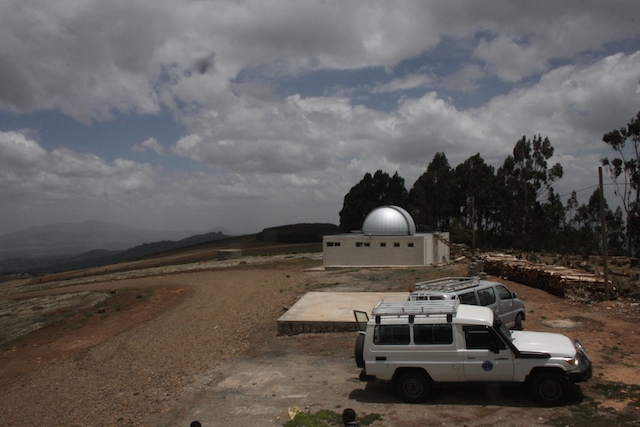
ADDIS ABABA, Jun 6 2014 (IPS) - High up in the eucalyptus-strewn Entoto Mountains, which overlook the Ethiopian capital, Addis Ababa, work is nearly complete on the country’s first observatory. Studying the stars and the galaxies will be vital for this Horn of Africa nation’s development and will hopefully also go a long way to developing brotherly love, say scientists who are part of the project.
“Space technology is often considered a luxury only for developed countries,” Solomon Belay, director of the Entoto Observatory and Research Centre , tells IPS. “But it’s actually a basic and vital need for development.”
He points out that space science technology and research can be applied to many basic necessities of life including health, energy, food security and environmental management.
Ethiopia’s highland topography — the observatory sits at 3,200m — and the ideal climate here, which includes the thin air and minimal cloud cover for most of the year, make it ideal for housing observatories from where you can observe the stars and galaxies.
Already another observatory is planned to be built near Lalibela, home to Ethiopia’s famous rock-hewn churches. It would be even higher at about 4,200m.
It is hoped that the observatories will kick start a scientific culture in Ethiopia, an important boost to socio-economic development, those involved tell IPS, as space science has applications in myriad areas in the public and private sectors.
Josef Huber, a systems engineer with German-based Astelco Systems  that built and installed the Entoto Observatory’s telescopes, who volunteers at a public observatory in Munich, Germany, points out that studying the stars is more than just about development.
“When people see Saturn for the first time, and it’s not just a picture, they’re really impressed,” he tells IPS.
“For many people their world is their home and neighbours — when you see beyond that, you will never fight with your neighbour, especially if you realise a star could explode and wipe out a galaxy.”
One of two telescopes at the Entoto Observatory and Research Centre  situated in the Entoto Mountains, overlooking the Ethiopian capital, Addis Ababa. Credit: James Jeffrey/IPS

One of two telescopes at the Entoto Observatory and Research Centre situated in the Entoto Mountains, overlooking the Ethiopian capital, Addis Ababa. Credit: James Jeffrey/IPS
The observatories will also provide training and research facilities for students at 33 Ethiopian universities, and will serve to attract international academia and scientists. It is hoped that Ethiopia will one day become the African version of Chile, a global hub for astronomy and research.
There are those who don’t share the enthusiasm, however. Recent media criticism has focused on donor countries continuing to provide millions of dollars of aid to African countries — Ethiopia remains a major recipient of foreign aid — that are embarking on aerospace adventures while many inhabitants continue to suffer in urban slums and rural villages.
“Ethiopian politicians have recognised the role space science can play in helping Ethiopia’s development, and are supporting generating investment in the country’s new observatories and space programme.” -- Abinet Ezra, the Ethiopian Space Science Society

It’s estimated that nearly 70 percent of the population in sub-Saharan Africa still live on less than two dollars a day. In Ethiopia it’s estimated that 29 percent of the population live below the poverty line.
Nevertheless, Ethiopia now has its four-million-dollar Entoto Observatory, housing two one-metre class telescopes, each of which weighs six tonnes and cost about 1.5 million dollars. It is the result of work by the Ethiopian Space Science Society (ESSS) , which was founded 10 years ago to address the lack of space science activity and interest in Ethiopia.
At ESSS’s inception, “most Ethiopian politicians were not ready for space science,” Abinet Ezra, communications director for ESSS, tells IPS.
In its early days ESSS had to import telescopes from the U.S., but that proved difficult due to foreign exchange rates, Abinet says.
“Science development is not easy in Africa,” Solomon adds. “Science needs political visibility otherwise it is not deemed important enough or allocated a budget.” He adds that economic strategies often weren’t linked to science and technology, with attention given instead to small-scale agriculture.
So far only a handful of African countries — such as South Africa, Nigeria, Egypt and Morocco — have space programmes that have launched satellites. But they’re likely to have company soon. In addition to Ethiopia’s efforts, Ghana and Uganda recently established space research programmes and are thought to be several years from putting satellites into space.
“Ethiopian politicians have recognised the role space science can play in helping Ethiopia’s development, and are supporting generating investment in the country’s new observatories and space programme,” Abinet says.
The coronet cluster is star-making hotspot. Credit: NASA, Chandra/CC By 2.0

The coronet cluster is star-making hotspot. Credit: NASA, Chandra/CC By 2.0
Currently very little astronomy is taught in sub-Saharan Africa outside South Africa, which the Entoto Observatory seeks to address by facilitating Masters and Ph.D. training in observational and theoretical astronomy, space science, and earth observation.
There could be also be financial rewards from a planned visitor centre and the observatory selling information garnered, such as real-time weather forecasting and trend data.
But it’s the intangible benefits that those involved seem most passionate about.
“Astronomy gets the young to embrace science and technology,” Solomon says. “And a space programme is an important tool to inspire students to enjoy physics and chemistry.”
“When I was a child I became interested in space science but couldn’t find anywhere to study it,” says 24-year-old Eyoas Ergetu, a mechanical engineer graduate student at Addis Ababa University, and part of the observatory’s team. “So it’s very exciting to be working here.”
ESSS wants Ethiopia to catch up with African countries that have launched satellites, and is lobbying the government to focus on getting Ethiopian satellites in space within the next decade.
These could help improve telecommunications, and the monitoring of activities such as mining and farming, and construction of major infrastructure like the Renaissance Millennium Dam Project. The dam project has been beset by controversy regarding its potential environmental impact since it was announced in 2011.
Already Ethiopia is using foreign-owned satellites for such purposes — while having to pay to do so.
Eyoas says he will start a graduate degree in aerospace engineering: “If Ethiopia is to launch satellites it will need experts to design them — I want to be one of those people.”
The signs are encouraging: next year a small satellite designed and constructed at Addis Ababa Institute of Technology (AAiT)  will become the first Ethiopian satellite in space, sent into space with another 49 satellites from various international organisations in a single rocket launch, as part of the European-based QB50 project.
This initiative aims to achieve sustained and affordable access to space for small-scale research space missions and planetary exploration. AAiT was the first African institute selected to participate.
And this year the International Astronomical Union (IAU)  signed an important agreement with Ethiopian partners to host an East African regional node of the IAU Office of Astronomy for Development. This is the first regional node to be established on the African continent as part of the IAU’s strategy to realise global societal benefits of astronomy.
“Development is not always sustainable,” Solomon says. “But if it comes through science and technology it is sustainable.”